Christian Pan is a writer based in New York City who has published more than a dozen novellas and over one hundred short stories focused on the erotic imagination since 2021. He also hosts the Pulse Session for the podcast All the Filthy Details, and is a contributing writer for Artistic Edge Magazine.

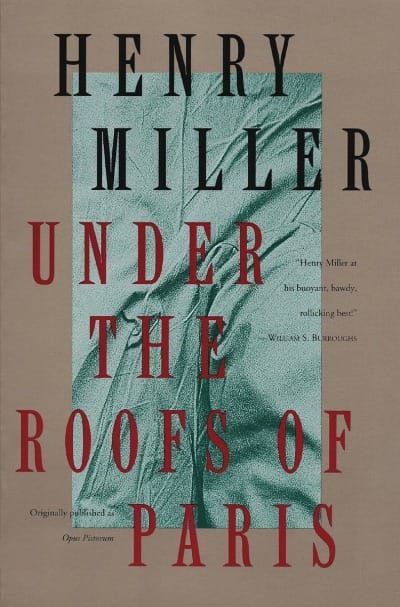
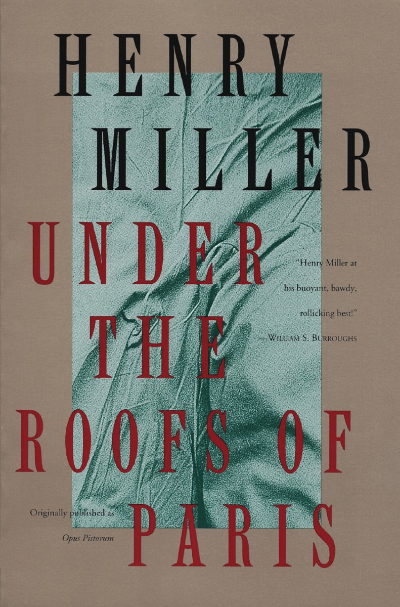
Sex, sex, and more sex. The kind you want to read in erotic fiction as well as a whole lot of episodes and situations you didn't expect, including ones that are hard to stomach. Under the Roofs of Paris might very well be one of the most explicit and profane books you will ever encounter; and yet, for all of the sex described in the pages of this novel, I'm not sure if I would necessarily call this book “erotic.”
True: every chapter of Henry Miller's 1941 book contains multiple sex scenes–between men and women, men with men, women with women, and groups of people completely entangled in their lust. But also true: few of these scenes contain tenderness or affection, nor the expressions of interest or declarations of enthusiastic consent some readers may expect from contemporary erotica. The characters wandering the streets of Miller´s fictional Paris are both brutish as well as brutally lecherous; their sexual encounters feel less than human, almost like wild animals pouncing upon one another in the jungle. Also, readers contemplating reading Under the Roofs of Paris should note that there are numerous passages in this novel which are quite unsettling, even if they are completely fictitious. In addition to all of its other sex scenes, the book contains a few scenes of pedophilia, including one of father-daughter incest. There are a number of scenes depicting sexual violence and rape, and instances where consent is dubious for these characters (frequently women). At one point, Miller extensively describes the orgiastic ritual of a secret Satanic cult over a few chapters; yet for me, in the context of the book as a whole, those didn´t disturb nearly as much as some of the other scenes. Under the Roofs of Paris is completely filthy, and about as far from political-correctness as one can get. It is not for the faint of heart.
As a writer, Miller rarely makes his truths palatable, choosing instead to put onto the page all of the filth, amorality, and detritus of humanity that he could. Frustrated by the conservative values of his time, his debut novel Tropic of Cancer blurs the line between fiction and autobiography, and challenged notions of what was considered “taboo” to include in American literature. Published in France in 1934, Tropic of Cancer remained unavailable in the US until 1964, after Grove Press, its publisher, won a series of lawsuits.
Living in Paris during the 1930s and working as a proofreader for the Chicago Tribune, Miller found influence from the surrealist movement of the time, the works of Dostoevsky, and began a key relationship with fellow writer Anais Nin which blurred artistic collaboration with sexual intimacy. He left France in June 1939, just before the Nazi occupation of Paris, first going to Corfu to compose The Colossus of Maroussi, a travelogue which he considered his best work but which struggled to find an audience. As conflict in Europe spread, he refused to return to his native Brooklyn, choosing instead to head out to Big Sur, California.
A respected and notorious writer who was nonetheless completely penniless, Miller befriended Milton Luboviski during the summer of 1940. He owned a bookstore in Hollywood, and offered to help Miller out by suggesting he write pornographic written material at a dollar a page (a little more than $22/page in today's rate of exchange), which Luboviski would then sell under the table through his store. These chapters would later become the chapters comprising Under the Roofs of Paris. Divided into six sections, the book's narrative frame is straightforward: Alf, an American expatriate living just about the poverty line in Paris, observes or participates in a variety of sexual encounters with multiple people. Nazism and the encroachment of fascism are never overtly mentioned in Miller's little-known novel, but I can't help but link the exceptionally explicit content of this book to the period during which Miller wrote it. Like with his earlier novel Tropic of Cancer, Under the Roofs of Paris raises a clenched fist against all forms of censorship or any forces which attempt to compromise artistic freedom. While a number of the passages contained in this book prove challenging–for their violence, their misogyny, their unflinching attitude towards characters we often would not like to read about, especially in erotic fiction–I admire Henry Miller's defiant attitude as an artist. Especially reading this book in 2024, when publishing controversial writing that involves sex is becoming more elusive than ever and so many platforms for publishing erotic material of any sort are introducing guidelines which are more restrictive than ever, a novel such as Under the Roofs of Paris is refreshingly uncomfortable, courageously disturbing, and artistically inspiring. Miller's book may not get off your libido, but I'm not sure that was ever the author's intent–at least, not in full.
I'm Dish and I write a weekly newsletter about life, love, and culture for those 40+. Because midlife and beyond is so much cooler than they said it would be. Hell yes, sign me up.